
Craniodontic Skull Teeth Connection
For many years dental research has studied the relationship of posture to the individual’s bite. And, unfortunately, even today most dentists believe that it is currently impossible to make a clinical diagnosis of whether the bite of each person is either normal or abnormal.
Traditional dentistry has no standard that is agreed upon to evaluate the patient’s bite condition as either normal or abnormal as it relates to posture.
This belief system resulted from dentistry’s inability to integrate information from the allied health professions namely osteopathic and chiropractic medicine.
The statement regarding dentistry’s inability to diagnose whether a patient’s bite is either normal or abnormal is now invalid.
My clinical research has established a unique occlusal/cranial paradigm that is practical, effective, and provides the means to clinically diagnose the bite of each patient and establish if it is normal or abnormal for their cranial design.
Each patient must be diagnosed and treated to correct their specific occlusal(teeth) imbalance as it relates to their cranial make-up.
The human species swallows 2 to 3 times per minute during the day and 1 to 2 times/minute during sleep. This translates into 2400 times per day. This simple act of swallowing brings the upper and lower teeth into contact. The upper “jaw”, maxillae, represents the anterior 2/3 of the base of the human skull. In essence the occlusion (bite) represents the self-correcting mechanism for balancing and re-balancing the twenty-eight skull bones.It stands to reason that a system that evaluates the direct impact of the teeth on cranial bone alignment would provide an accurate guide to correcting the bite. Such a system now exists.
Craniodontics (relationship between the function of the teeth and skull) provides the answer: Four cranial indicators are used to access the balance or imbalance of the skull bones of each patient. Once skilled in cranial palpation, this evaluation system can be accomplished efficiently and without invasive techniques. Once the baseline position of each of the four indicators has been established the same indicators are then reevaluated with the occlusion (bite) in contact. The effect of the occlusal contact on each of the four indicators is noted. The teeth are then evaluated (one-by-one) to determine which ones are causing the specific cranial distortion(s). This process can be done in one visit when the patient has a full or nearly full complement of teeth. Treatment involves correcting the cranial distortions then removing the occlusal (teeth) interferences (microns of adjusting) which when corrected result in BALANCING EACH OF THE FOUR CRANIAL INDICATORS! The key to this puzzle is the simultaneous correction of the cranial faults and occlusal interferences at the same visit. Each case must be judged on its own merits. Some cases can be resolved in one or two visits. Others take 7 or 10 visits. Some cases require years of treatment and multiple procedures: dental orthopedics (ALF System), orthodontics, reconstruction (partials, full dentures, overlays, bridges, etc.).
Unfortunately, few doctors have ever focused in on this connection and resulting treatments have failed to correct the underlying cause(s). Since the brain and spinal cord are wrapped in a membrane system (dural membrane) and attachment extends all the way down to near the tail bone, distortions which occur in the head and neck region translate downward with the potential of causing a compensated spinal curvature (scoliosis), pain and physiologic distortions (Autonomic Nervous System, Central Nervous System, hormones, meridian energy imbalances, etc.).
Craniodontic Connection Between Skull and Teeth Case Study
44-year-old female dentist presented the following chief complaints:
- Severe Temporal Headaches – past 10 years
- Bilateral Tinnitis (ringing) – past 15 years
- Popping and clicking in both TM joints
- Bruxism
- Numbness and tingling on left thumb and arm
- Fatigue – wakes up tired every morning
- Dryness of right eye – last 2 to 3 months
- Severe vertigo (motion sickness)- unable to fly; problems driving
- Pain in the right leg, thigh, behind knee and buttocks
- Muffled hearing
- Neck pain
- Pain over the right ovary
- Pain in lower left first molar – past 4 to 5 years: root canal Tx done three times with no change in pain level. Apico (surgical procedure: drill hole in the bone at end of root; cut tip of root and debrib tissue in surrounding area) recommended
Cranial Evaluation:
- Sphenoid: High on right- roll distortion
- Mastoid: Left is Anterior and locked- yaw distortion
- Amplitude: Unilaterally weak on left
- Sphenobasilar Symphysis: Right sidebend (yaw) torsion (roll) with sphenoid high on right.
- Flexion/Extension motion: Severe pulling of occiput to right during inhalation (pitch distortion)
Clinical Findings:
Muscle Evaluation
- Right Internal Pterygoid painful to palpation
- Right and left External Pterygoids painful to palpation
Physiologic Evaluation
- Blocked Regulation: Decreased energy flow in ANS due to Hg (mercury)
- Focus (Interference Field):
- Staph infection in right side of thyroid
- Staph & strep infection in root canalled teeth #19 & 27
Psychokinetic Evaluation
- Anger: liver/gall bladder
- Bach Flower Essence: Elm
Dental/Cervical/Pelvic Evaluation
- C-1 Right
- C-2 Right
- C-3 Left
- C-4 Left
- C-5 Left
- C-6 Right and left
- Left pelvic muscles are weak when muscle tested
- Right sacroiliac weak with biting down
- 80% rotational distortion to the right- torque in the spine
- Neuro Occlusal interference on #28 (lower right first bicuspid tooth)
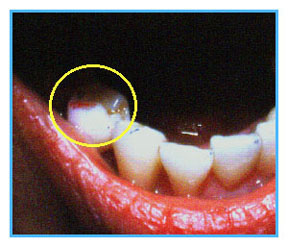
Treatment: First and second visit August 11 & 12, 2000
- Cranial adjustment
- Neuro Occlusal adjustment(adjust only the area that is causing the problem; diagnosis made with vibrational medicine technology
- Biofrequencies (destroys pathogens without injuring surrounding tissues) for infected root canalled tooth & thyroid
- DMPS subcutaneous injection around thyroid & i.m.
- Bach Flower Essence – Elm
Progress: Changes occurred within 24 hours of treatment!
- Vertigo – completely resolved
- Headaches – completely resolved without any appliance!
- Root canalled tooth pain- completely resolved!
- Right leg, knee and buttock pain- completely resolved!
- Dryness in right eye- completely resolved!
- Bruxism- completely resolved!
- Tinnitis- completely resolved!
- Cervical pain- completely resolved!
- Fatigue- Improved with DMPS injection on August 29, 2000
This complicated series of chief complaints was being caused by several major factors (cranial distortions, mechanical tooth interference, mercury poisoning, residual infection in an old root canalled tooth, underactive thyroid and emotional issues). Traditional medicine and dentistry have no idea that some of these issues even exist or how they interrelate. Most patients that present with these types of symptom clusters are viewed as crazy.
Case treated by Dr. Gerald H. Smith
FREE PRESENTATION
Download the slides from Dr. Smith's presentation on the Dental Whole Body Connection in Ontario on October 25, 2024.
A comprehensive seminar to awaken you to the potential dangers of dental treatments.
STAY INFORMED
Big tech and mainstream media try to suppress the powerful information I have to share. Subscribe here to stay informed!